


Watch Video
Upload in progress...
Your video file is being uploaded. The currently loaded video is the source file.
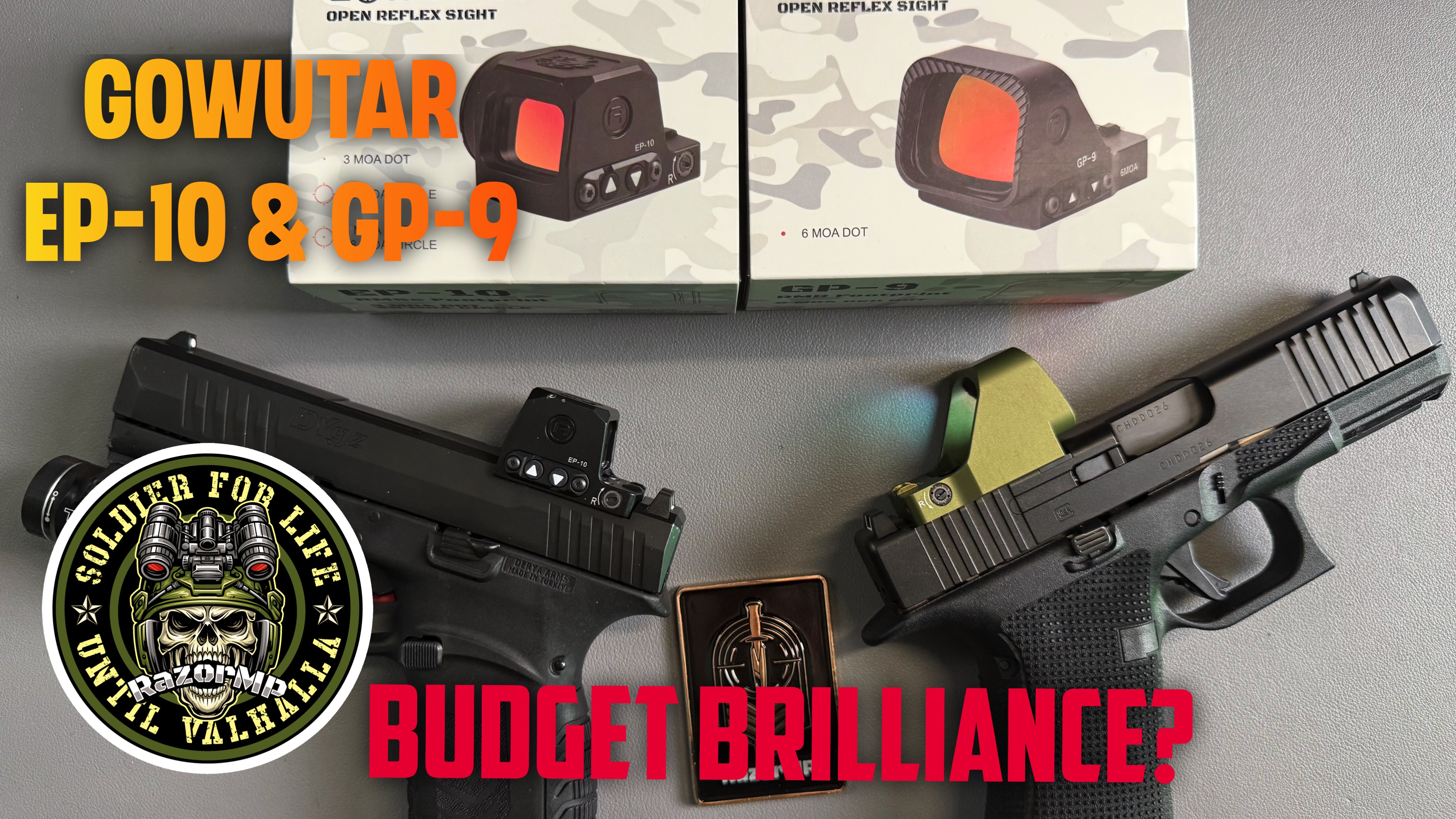
Hands-on look at the Gowutar EP-10 and GP-9 with parts links below.
Gowutar EP-10: Click Here!
Gowutar GP-9 Green: Click Here!
Today I am taking a look at two pistol optics from GOWUTAR: the GP-9 and the EP-10. This is not a head-to-head comparison where one wins and the other loses. These two dots are aimed at different use-cases, and the smarter way to think about them is: what does each one do well, where does it give up ground, and what kind of shooter is it actually for?
Both optics were sent to me for review. I am not an affiliate for GOWUTAR and I do not earn commission from anything in this article. I may have a discount code available for the GP-9, but I do not get paid from that code either. At the end of the day, the optics still have to perform on the range like anything else.
As always, everything here is for informational and educational purposes only, and all handling and testing is done safely in a controlled environment.
First up is the GP-9. I have already done a full deep dive on this optic elsewhere, so I am not rehashing every detail here. This is more of a recap with context for anyone trying to understand where it fits.
The unit I am running is the green version, and one thing GOWUTAR does offer across this line is multiple color options, so if you care about matching the look of your setup, that is part of the appeal.
For context, I previously ran the GP-9 on the Fusion Firearms XP Pro Comp, which is a full-size setup where a larger window optic makes a lot of sense. That pairing highlighted what the GP-9 does best:
If your shooting is more about pushing tempo, transitions, and staying on the dot while moving fast, the GP-9 makes a lot of sense, especially on full-size pistols where speed is the priority.
The tradeoffs are pretty straightforward. A larger, bolder dot setup tends to buy you speed more than it buys you tiny groups at distance. And since the GP-9 is an open emitter style optic, it is more exposed to real-world issues like dust, lint, rain, and debris. That does not automatically disqualify it for serious use, but it does mean it is happiest on a gun that gets trained with regularly and maintained like you actually care about your gear.
Bottom line on GP-9: If you want a dot that feels quick, forgiving, and easy to run hard on a full-size pistol, the GP-9 is built for that lane.
Now the bigger everyday practicality story here is the EP-10.
The EP-10's strongest advantage is simple: enclosed emitter design. Anyone who carries a dot day to day already knows the reality, stuff gets everywhere. Lint, dust, sweat, rain, and all the little annoyances that do not show up when the gun lives on a clean bench. Enclosed emitters exist specifically to reduce that problem and keep the dot usable when conditions are not perfect.
Here is what GOWUTAR claims on the EP-10, feature-wise:
Price-wise, the EP-10 sits around 188.99 Scooby Snacks.
I ran the EP-10 on my Derya DY9Z, a sub-compact platform that this optic was basically made for with the RMSc footprint. Through my strings, the dot did not flicker, it did not bloom for my eyes, and I did not have any reliability issues from the optic. It stayed on, stayed usable, and did what a practical carry dot is supposed to do.
The cons on the EP-10 are basically micro-dot realities:
The best way to judge the EP-10 is simple: does your eye pick it up quickly, does it look clean across brightness settings, and does it stay reliable when it is used like a real carry optic?
Bottom line on EP-10: This one makes the most sense for concealed carry, home defense, and duty-style use where you want more protection from the environment and less babysitting.
In my use so far, both optics have been accurate, held zero, and behaved reliably through my range strings, no flickering, no random shutoffs, no weird behavior. They just ran.
Big thanks to GOWUTAR for sending them out. I will keep evaluating longevity over time, because long-term durability is the part you cannot fully prove in a short window. But so far, everything checks out.
As always, I will see you on the high ground or in the next post. RazorMP out.